














Buckshot Roulette is a short-form game built around turn-based risk and limited information. The player participates in a sequence of rounds where decisions are made using a single weapon loaded with an unknown arrangement of live and blank shells. The objective is not speed or accuracy, but survival through calculated choices. Each turn forces the player to weigh probability against consequence, making even simple actions carry long-term impact.
Core rules and setup
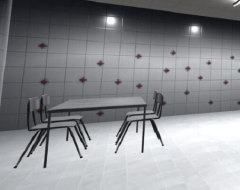
The game takes place in a confined setting with only a few interactive elements. At the start of each round, the weapon is loaded, but the exact order of shells is hidden. The player and the opponent take turns deciding how to act, with limited tools available to influence the outcome. These tools provide partial control, such as revealing information or changing turn order, but never remove uncertainty completely. This structure ensures that every round remains unpredictable despite repeated play.
As rounds progress, the number of variables increases. Additional mechanics are introduced gradually, expanding the range of possible decisions without changing the core loop. The environment remains static, which keeps attention on the rules rather than presentation. The absence of traditional progression systems shifts focus toward understanding probability and managing limited resources under pressure.
Decision-making and tension
Buckshot Roulette relies on delayed consequences. A choice made early in a round may only reveal its effect several turns later. This creates tension through anticipation rather than action. The player must decide when to act aggressively and when to wait, often with incomplete information. Mistakes are not framed as failure, but as part of the system’s logic.
Key gameplay components include:
· alternating turns between player and opponent
· unknown distribution of live and blank shells
· limited-use items that affect information or flow
· permanent consequences within a round
· reset-based structure between matches
Pacing and replay structure
Each match is relatively short, which encourages replay. Because outcomes depend on random elements combined with player choice, repeated sessions rarely play out the same way. The pacing remains consistent, with no interruptions from cutscenes or external systems. This makes the experience focused and contained.
Over time, players develop personal strategies based on risk tolerance rather than optimal solutions. The game does not reward mastery in a traditional sense, as uncertainty always remains. Buckshot Roulette uses repetition to highlight how decision-making changes when information is limited and consequences are unavoidable. Its structure emphasizes probability, restraint, and acceptance of outcomes within a closed system, making each round a self-contained test of judgment rather than skill progression.
