
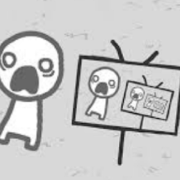

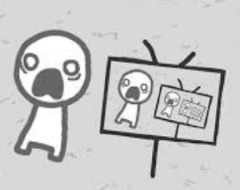












We Become What We Behold is a short interactive game focused on observation and influence within a closed social space. The player takes the role of an unseen photographer whose actions shape how characters behave toward each other. The game is played from a fixed perspective, where small, abstract characters move freely inside a circular area. There are no traditional goals, scores, or progression systems. Instead, the experience is driven by how attention and repetition alter behavior over time.
Observation as interaction
At the beginning, the characters behave neutrally, interacting without conflict. The player can choose where to point the camera and when to take photos. Each photo captures a specific action or interaction, which is then broadcast back to the group. The game establishes a direct link between what is observed and what becomes normalized. By selecting certain moments over others, the player indirectly encourages repetition of similar behavior among the characters.
The interface remains simple, limiting player input to camera movement and timing. This restriction places responsibility on choice rather than mechanical skill. The game does not explain consequences in advance, requiring the player to infer cause and effect through repetition. Over time, patterns emerge based on what the player chooses to record.
System behavior and feedback
The core system reacts to visibility. Behaviors that are shown more frequently begin to spread across the group. This applies equally to neutral and harmful actions. The player cannot intervene directly, only highlight moments through the camera. Feedback is immediate but subtle, reflected in how characters adjust their actions after each broadcast.
Key interactive elements include:
· selecting moments to capture
· controlling camera position
· influencing group behavior through visibility
· observing changes without direct control
· triggering shifts through repetition
Escalation through repetition
As the game continues, the environment becomes more reactive. Characters begin to respond not only to each other, but to what they believe is expected. The player’s role becomes less about discovery and more about responsibility. The system does not prevent escalation once certain patterns are established, reinforcing the idea that attention can amplify behavior regardless of intent.
The pacing remains constant, with no breaks or level transitions. This uninterrupted flow keeps focus on the gradual change rather than isolated events. The lack of choice reversal means that earlier decisions shape later outcomes in a fixed way.
We Become What We Behold concludes without offering resolution or evaluation. There is no summary or judgment of the player’s actions. The game ends once the system reaches a stable outcome shaped entirely by observation choices. By limiting interaction to visibility and repetition, the game presents a closed model of influence where attention alone is enough to alter collective behavior.
