







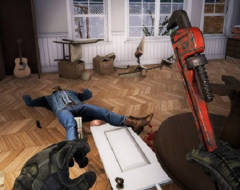









Schedule I is a simulation game centered on building and managing an illegal operation inside a fictional urban environment. The player begins with no resources and must gradually establish production, distribution, and control through direct involvement. The game is played from a first-person perspective, placing the player inside the city rather than above it. There is no scripted storyline, and progress depends entirely on how effectively systems are understood and used over time.
Urban space and player agency
The city in Schedule I functions as an interconnected system rather than a background. Streets, buildings, and neighborhoods exist to support movement, transactions, and risk management. The player navigates the environment to meet contacts, deliver products, and secure locations for production. Law enforcement presence and civilian behavior operate independently, responding to repeated player actions rather than isolated events. This makes the city feel persistent, where patterns matter more than single decisions.
There are no mandatory missions guiding progression. Instead, players choose how to expand, whether slowly and quietly or through faster, riskier growth. Property acquisition and location choice influence efficiency and exposure. The lack of direct instructions encourages experimentation and learning through consequence rather than guidance.
Production and management systems
At the core of Schedule I is a layered management structure. The player must oversee production while also handling logistics and supply chains. Materials need to be sourced, processed, and moved without drawing unwanted attention. Each system operates continuously, which means neglecting one area can create problems elsewhere.
Key systems involved in progression include:
· sourcing and managing raw materials
· producing and refining products
· organizing storage and distribution
· monitoring risk and exposure
· reinvesting profits into expansion
Risk, pressure, and decision-making
As operations grow, pressure increases from multiple directions. Higher output attracts customers but also increases visibility. Law enforcement response scales gradually, forcing the player to adapt strategies. There is no instant failure, but repeated poor decisions can limit options and slow growth. This creates a feedback loop where caution and planning become more important over time.
The game does not provide clear success metrics. Instead, players evaluate progress through stability, reach, and control. Mistakes are part of the system, and recovery is possible if adjustments are made early enough.
Progression and long-term play
Schedule I is designed for extended play without a defined endpoint. Expansion introduces more complexity rather than closure. Players may choose to focus on efficiency, scale, or control depending on preference. Cooperative play allows shared responsibility, but systems remain consistent regardless of player count.
